Alphabet M Mini Book: A Hands-On Letter Learning Tool
Why This Mini Book Stands Out for Early Learners
You know that moment when a child's eyes light up because they finally recognize a letter? That's exactly what the Alphabet M Mini Book is built to create. It's not just another worksheet stack—this is a thoughtfully designed, seven-activity booklet that turns letter M into something kids can trace, color, find, and truly own. For anyone working with preschool or kindergarten learners, whether you're a teacher, homeschool parent, or tutor, this resource fills a very specific gap: making foundational literacy practice feel like play rather than homework.
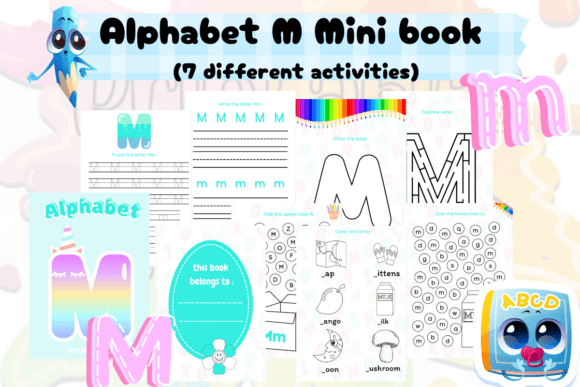
The visual design is clean and approachable. Activities flow in a logical sequence, starting with tracing uppercase and lowercase M, then moving into independent writing, dab exercises, a maze challenge, bubble letter coloring, beginning sounds vocabulary work, and a personalized cover page. Each page gives children a different way to interact with the letter, which matters because young learners process information through multiple channels. Some kids need the tactile feedback of tracing. Others connect through color. A few respond to spatial challenges like mazes. This mini book respects all of those pathways.
What Makes the Activities Work So Well Together
Let's talk about the structure, because that's where this resource really shines. The seven activities aren't random—they build on each other in a way that mirrors how children actually learn letter recognition and formation. Tracing comes first because it establishes muscle memory. Then kids write independently, which tests whether that memory has taken hold. The dab activity adds a motor-skill twist that keeps things fresh, while the maze sharpens visual discrimination. By the time a child reaches the bubble letter coloring page, they've already engaged with M in four different formats. The beginning sounds section ties it all together by connecting the letter to real vocabulary: map, mittens, milk, mushroom.
Those vocabulary choices aren't accidental either. Each word starts with a clear, crisp M sound that young ears can isolate. There's no ambiguity—no words where M blends into a cluster or gets overshadowed. That kind of phonics precision matters enormously when you're building a child's foundational understanding of how letters and sounds relate. It's the difference between a resource that looks cute and one that actually teaches.
Practical Applications Across Different Learning Environments
One of the strongest aspects of the Alphabet M Mini Book is its flexibility. You can print it as a complete booklet for a letter-of-the-week unit, or pull individual pages for morning work, literacy centers, or quick assessments. If you're running a classroom, these pages slide perfectly into rotation alongside your other letter M activities. Homeschool families appreciate that the whole pack can become a standalone mini lesson that takes fifteen to twenty minutes. Tutoring centers use individual sheets as diagnostic tools to see where a child might be struggling with letter formation.
The cover page is a small detail that makes a surprisingly big difference. When kids write their name on the front of their own mini book, they feel ownership. That sense of ownership translates directly into engagement. Suddenly it's not a worksheet—it's their book. That psychological shift is something experienced educators understand intuitively, and this resource bakes it right into the design.
Fine Motor Development and Visual Discrimination Skills
Beyond letter recognition, this mini book quietly targets several developmental skills that parents and educators sometimes overlook. The tracing and writing activities build fine motor control, which is essential not just for literacy but for everyday tasks like buttoning coats and holding utensils. The dab exercises require hand-eye coordination and controlled grip pressure. The maze challenges visual discrimination—the ability to notice differences between similar shapes, which later supports reading fluency when children need to distinguish between b, d, p, and q.
What's smart about the design is that none of this feels clinical. A child working through the Alphabet M Mini Book doesn't think, "I'm developing visual discrimination skills." They think, "This maze is fun" or "I want to color this big M yellow." The learning objectives hide inside activities that genuinely entertain, which is exactly how early childhood education should work.
How to Get the Most from This Resource
If you're using this as part of a letter-of-the-week curriculum, consider pairing it with sensory activities that reinforce the M sound. Have children trace M in sand trays or build it with playdough before they work through the booklet. Read picture books featuring M words. Sing songs with M-heavy lyrics. The mini book becomes one station in a larger ecosystem of learning, and that multi-sensory approach dramatically improves retention.
For take-home learning, the booklet format is ideal. Parents who might feel intimidated by educational jargon can simply hand their child the book and let them work through it. The activities are self-explanatory, the instructions are clear, and the progression feels natural. No special materials required—just crayons or markers and a pencil.
The Alphabet M Mini Book represents what good educational design looks like: purposeful activity selection, clean visual presentation, developmental awareness, and genuine respect for how young children learn. At its price point, it's a practical addition to any early literacy toolkit, whether you're building a complete alphabet series or just need solid letter M materials for your next unit.